
Why Yahoo Email Addresses Are the Hardest to Verify (And What Actually Works)
If your email list has any meaningful size, chances are a big chunk of it is sitting on Yahoo — "@yahoo.com," "@ymail.com," "@rocketmail.com," and a handful of country-specific Yahoo domains are still some of the most common addresses people give out.
Which is exactly why it's a problem that Yahoo also happens to be one of the most stubborn providers to verify against.
Most people assume email verification is simple: you ping the mail server, ask if the address exists, and get a yes or no. That's roughly how it works for providers like Outlook or smaller business domains. Yahoo, on the other hand, seems almost designed to make that conversation as unhelpful as possible — and understanding why is the key to understanding what separates a good verification tool from one that's just guessing.
The Basic Idea: An SMTP "Knock on the Door"
Verification starts with a DNS lookup to find the mail servers (MX records) responsible for a domain, then opens an SMTP connection and walks through a sequence of commands — EHLO, MAIL FROM, and finally RCPT TO — essentially asking "does this mailbox exist?" without sending an actual message. The server's three-digit response code is supposed to settle the question: 250 means yes, 550 means no.
For Yahoo, that response code rarely tells the whole story.
Yahoo's Bag of Tricks
Here's where things get interesting. Yahoo's mail servers are tuned to be cautious with unfamiliar connections, and that caution shows up in a few specific ways:
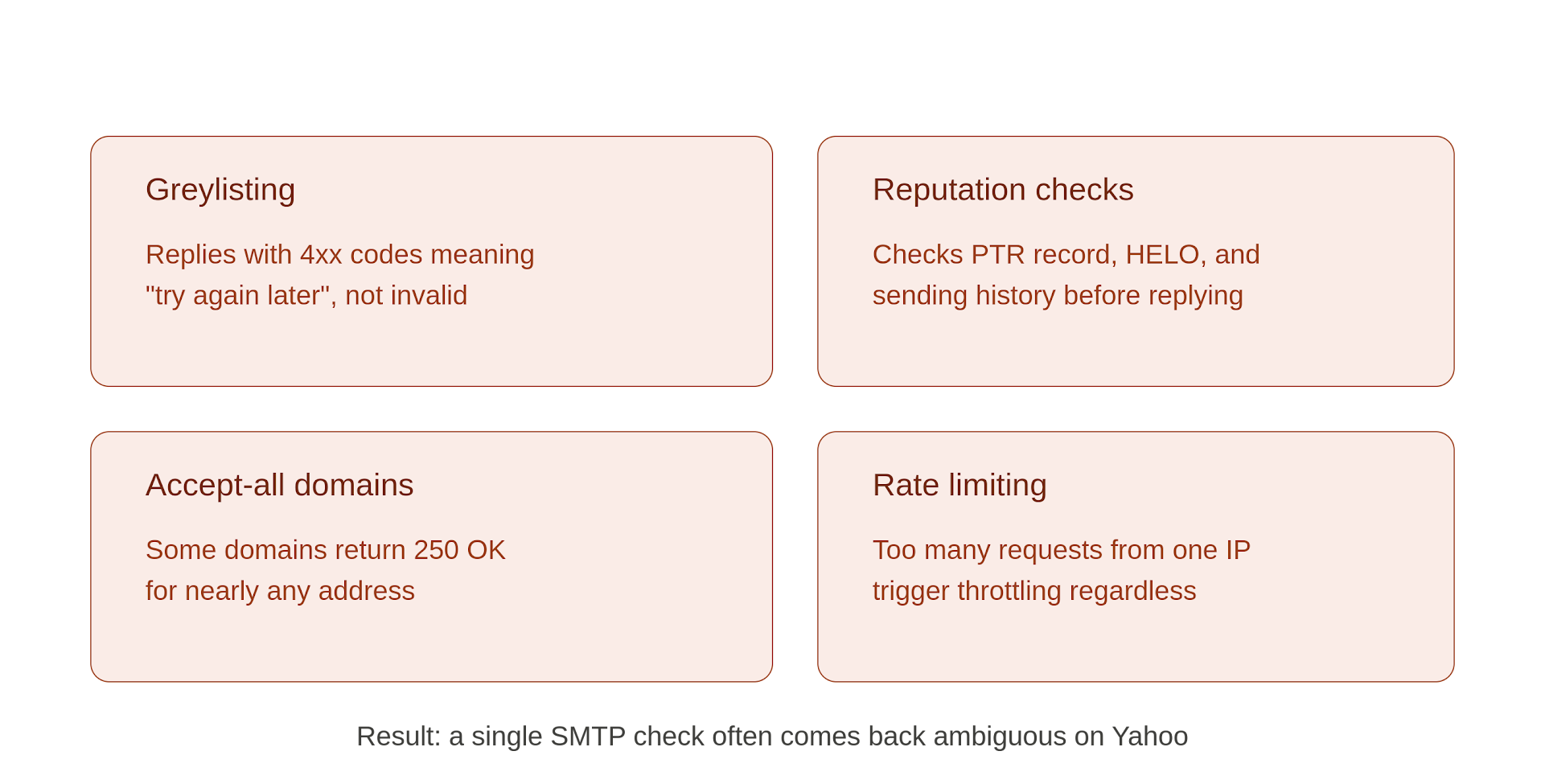
- Greylisting – instead of a clean answer, Yahoo often replies with a temporary 4xx code (think 450 or 421), which basically means "try again later" rather than "this address doesn't exist"
- Reputation checks on the verifying server – Yahoo looks at the reverse DNS record, the HELO hostname, and the sending history of whoever's asking, before deciding how forthcoming to be
- Accept-all domains – some Yahoo-hosted domains will say 250 OK to almost anything, pushing the real existence check further down the pipeline
- Rate limiting – send too many RCPT TO requests too quickly from one IP, and Yahoo starts throttling the connection altogether, regardless of whether the addresses themselves are valid
Put it all together, and a single SMTP check against Yahoo can come back ambiguous for reasons that have nothing to do with whether the email address is real. This is precisely the scenario where a lot of popular email verification tools — ZeroBounce, NeverBounce, Kickbox, and similar services included — tend to lose accuracy specifically on Yahoo and other defensively-configured providers. Even tools that work well on Gmail or business domains can return a much higher share of "unknown" or misclassified results once Yahoo addresses enter the mix.
What Separates Accurate Verification From a Coin Flip
Rather than treating one ambiguous SMTP response as the final word, a verification engine built for Yahoo's quirks needs to layer several techniques together.
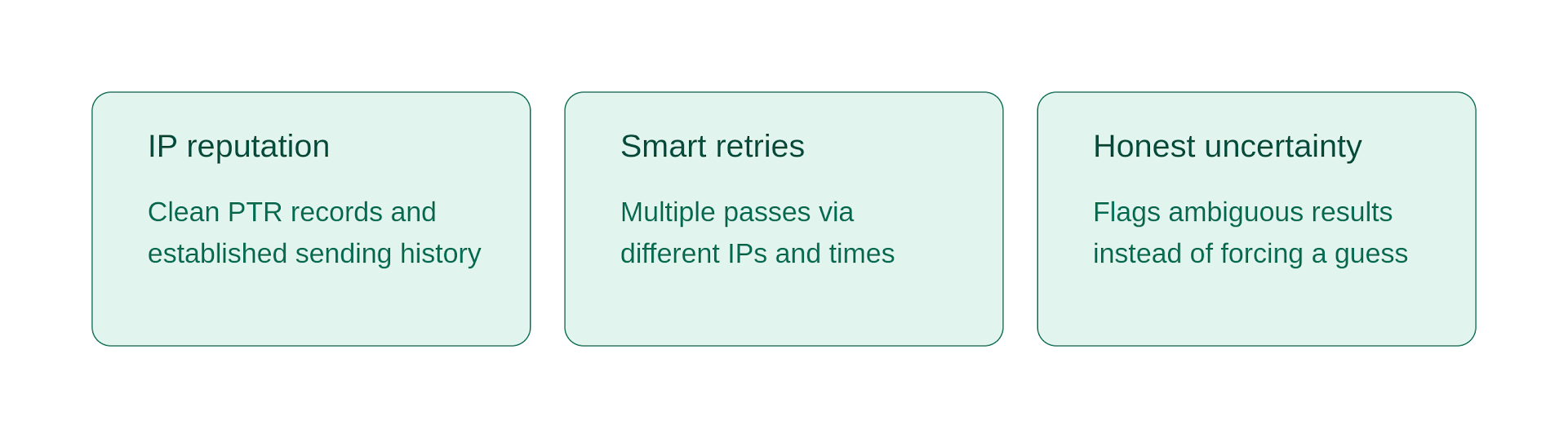
Verification requests should be routed through reputation-managed IP pools — servers with clean PTR records and consistent HELO configuration, so Yahoo is less likely to greylist the very first attempt. When a 4xx response does come back, the address shouldn't be immediately written off; it needs to be queued for a retry pass, often through a different IP and at a different time, because Yahoo's willingness to respond clearly tends to shift with server load and connection history.
There's also a layer of pattern recognition that matters at the domain level. If a Yahoo-hosted domain is consistently returning 250 OK no matter what's in the local part of the address, that's a sign of an accept-all configuration — and a verification result shouldn't be reported as a confident "valid" when the SMTP layer genuinely can't confirm it.
And critically, when none of that resolves the ambiguity, the honest move is not to force a guess. Marking an address as "risky" or "unknown" sounds less satisfying than a clean valid/invalid split — but it's far more useful than a false positive that bounces three weeks into a campaign.
Why Any of This Should Matter to You
It's tempting to think of list verification as a one-time cleanup chore, but the stakes are higher than that:
A hard bounce against a dead Yahoo address doesn't just fail silently — it dings your sender reputation in ways that can affect inbox placement across every provider, not just Yahoo Yahoo's bulk sender requirements now expect SPF, DKIM, and DMARC authentication plus low complaint rates — a list riddled with invalid addresses works directly against that Every address wrongly flagged as "invalid" because of a greylisted check is a real contact you're losing from your campaigns for no reason Every dead address wrongly passed as "valid" because Yahoo gave an ambiguous 250 is a bounce waiting to happen on your domain
The Bottom Line
Yahoo doesn't make this easy, and honestly, that's by design — the same defenses that frustrate verification tools are also what keeps spammers from harvesting addresses wholesale. The difference between a verification result you can trust and one that's basically a coin flip comes down to infrastructure: reputation-managed IPs, smart retries, and a willingness to say "we're not sure" when that's genuinely the case. If a tool — whether it's ZeroBounce, NeverBounce, or something else entirely — can't show its work on exactly these points, its Yahoo results are worth a second look.
Want to see how your Yahoo addresses actually hold up? Run a free check at bouncify.io and see the difference proper verification makes.