How Email Validation APIs Improve Deliverability and Reduce Bounce Rates
To maintain high deliverability, email validation must be treated as a core infrastructure layer rather than a one-time cleaning task.
High-volume senders who ignore data hygiene inevitably face reputation decay; when invalid addresses or "zombie" accounts trigger hard bounce rates above the 2% ISP threshold, providers like Gmail and Outlook respond by throttling traffic or routing messages directly to the spam folder.
Bouncify’s Email validation API prevents this by performing real-time SMTP handshakes and syntax checks to intercept toxic data at the point of ingestion, ensuring only deliverable, high-value addresses enter the sending pipeline. This proactive defense stabilizes inbox placement, provides accurate engagement analytics, and ensures infrastructure scales without being sidelined by ISP filtering systems.
In the high-stakes environment of enterprise email deployment, throughput is often mistaken for productivity. However, for deliverability engineers and technical stakeholders, the primary metric of success isn't just volume—it’s the integrity of the SMTP handshake and the subsequent inbox placement. In an era where ISPs like Gmail and Yahoo utilize sophisticated machine-learning models to evaluate sender intent, maintaining a pristine data pipeline is a technical necessity.
Implementing Bouncify’s Email validation API functions as a critical firewall at the ingestion layer. By programmatically filtering out toxic data before it reaches your Mail Transfer Agent (MTA), you mitigate the risk of reputation decay and ensure that your infrastructure remains compliant with the tightening constraints of engagement-based filtering.
The Anatomy of a Bounce: Why ISPs Care About Your Data Quality
Every time you attempt to deliver an email to an address that no longer exists (a "hard bounce"), the receiving ISP takes note. From the perspective of Gmail, Outlook, or Yahoo, a high volume of hard bounces is a primary indicator of poor sending practices, such as purchased lists, poor list hygiene, or a lack of ingestion control.
The 2% Threshold and Reputation Decay
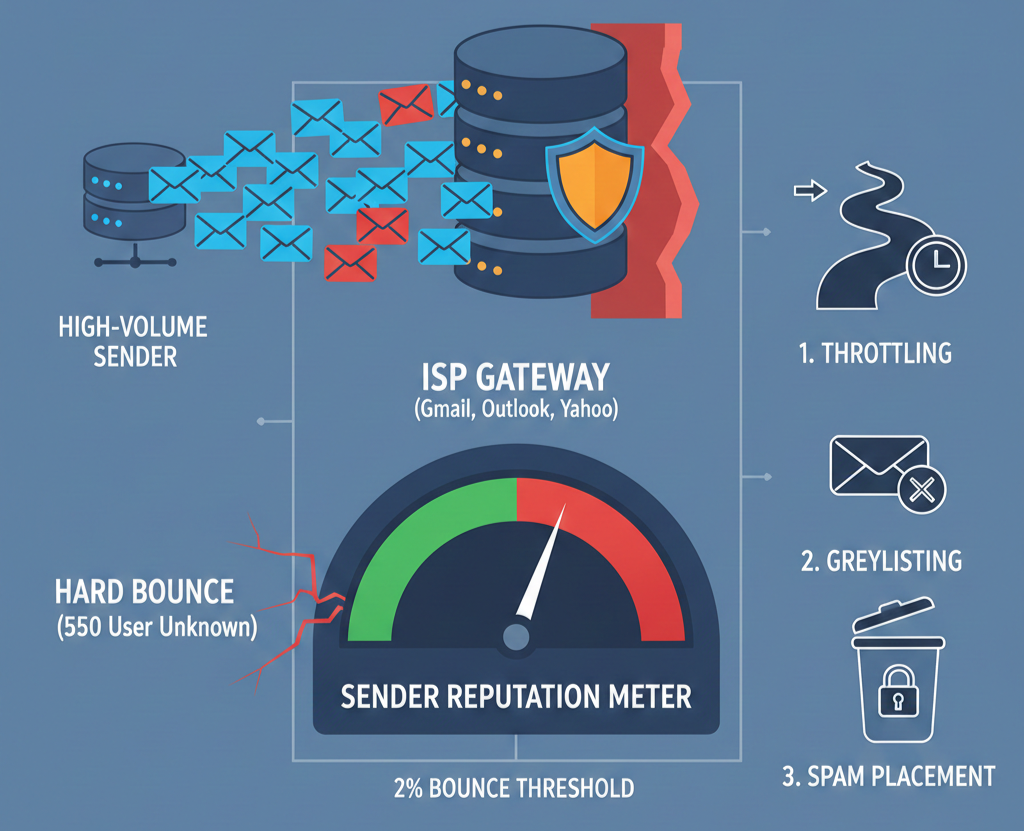
While ISPs do not publish their exact algorithms, the industry-standard benchmark for a sustainable hard bounce rate is under 2%. Once you consistently exceed this threshold, your sender reputation begins to decay. Reputation decay manifests in three stages:
1.Throttling: ISPs slow down your delivery rates, causing significant delays and SMTP 421 response codes.
2.Greylisting: Your emails are temporarily rejected, forcing your MTA to retry, which can lead to further delivery failures.
3.Spam Placement: Even legitimate, opted-in subscribers stop seeing your emails because your domain and IP have been flagged as "low trust."
Using a bulk email validation tool before campaigns ensures your bounce rate remains well within acceptable limits.
How Bouncify Intercepts Risk at the Protocol Level
A robust email validation API performs a multi-stage technical audit of every address to ensure it meets the highest standards of deliverability.
- Syntax and RFC Compliance: The API first ensures the local-part and domain-part adhere to IETF standards (RFC 5321/5322), discarding malformed entries.
- DNS and MX Record Verification: Bouncify queries the Domain Name System to confirm that the recipient domain is active and possesses valid Mail Exchange (MX) records.
- SMTP Deep-Level Handshake: This is the core validation process. The API initiates a connection to the recipient’s mail server, performs the
HELO/EHLOandMAIL FROMsequence, and issues aRCPT TOcommand. By analyzing the server's response code without actually transmitting the DATA payload, the API confirms mailbox existence without affecting the recipient’s experience. - Risk Categorization: Beyond existence, Bouncify identifies disposable domains, role-based accounts (e.g.,
info@), and potential spam traps that could lead to blocklisting.
Verify Your Email List with Bouncify
Protect your sender reputation before your next campaign. Verify your email list in minutes to ensure high inbox placement.
Managing Data Decay and Legacy List Volatility
Email data is a volatile asset, experiencing a natural decay rate of approximately 22.5% annually. This degradation is driven by personnel turnover, domain expirations, and mailbox abandonment. Re-engaging a legacy email list without a prior verification pass is one of the fastest ways to trigger a blocklist event.
When you send to a large volume of "stale" addresses, you are likely to hit recycled spam traps. Bouncify identifies these high-risk nodes, allowing you to purge them before they compromise your inbox placement. ISPs monitor the ratio of "Active Users" to "Unknown Users"; if you suddenly send to 10,000 old addresses and 2,000 return a 550 User Unknown SMTP response, your reputation will likely be suppressed immediately.
Strategic Integration: Validation as a Continuous Workflow
For high-volume senders, validation should be integrated at two primary points in the data lifecycle:
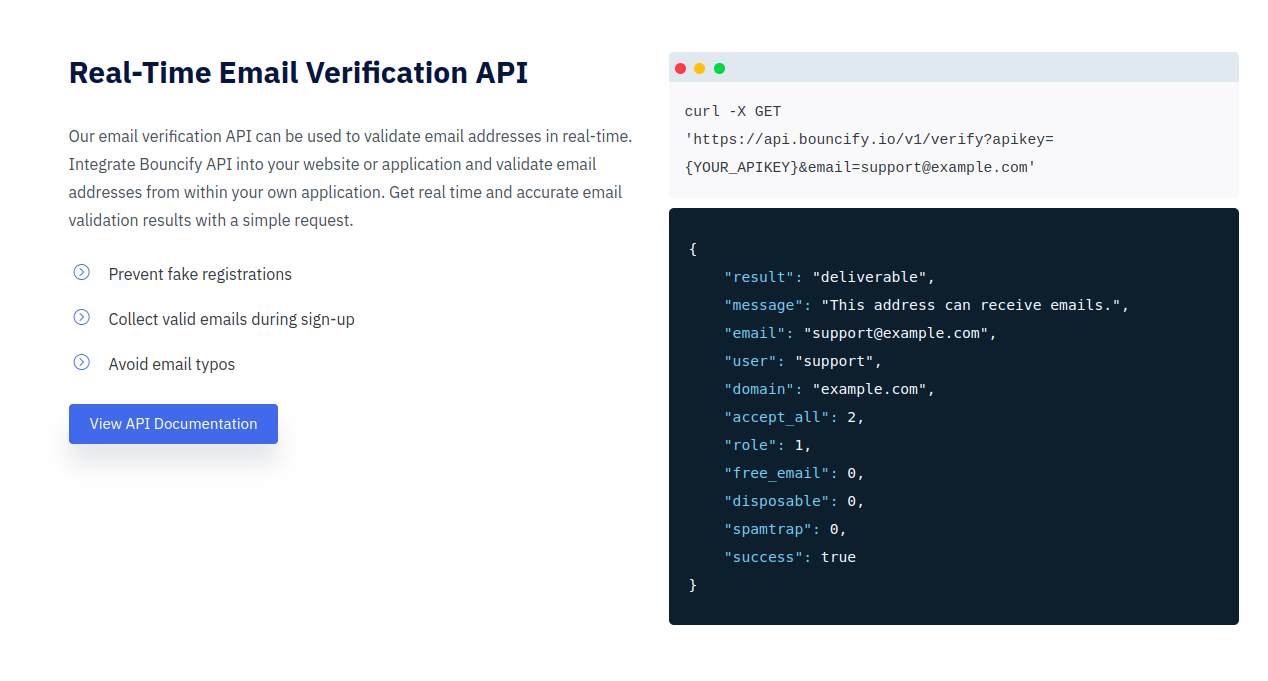
Real-Time Ingestion: By embedding the Bouncify API into sign-up forms, you prevent typos and bot-generated data from ever entering your CRM. This ensures that your initial engagement signals are 100% deliverable, which is crucial for building early-stage domain trust.
Pre-Flight Batch Processing: For re-engagement efforts targeting users who have been inactive for over 90 days, a batch verification scan acts as a final safeguard. This process removes addresses that have deactivated in the interim, ensuring your hard bounce rate remains negligible.
Conclusion: Future-Proofing Your Deliverability
In the modern email landscape, email deliverability is a reflection of your technical infrastructure. Treating an email validation API as a foundational component allows you to scale your communications with confidence. By automating the identification of invalid, risky, or high-maintenance addresses with Bouncify, you protect your sender reputation and ensure that your infrastructure is optimized for the inbox.
Practical Next Steps:
- Audit Ingestion Points: Implement Bouncify's real-time API checks on all public-facing forms.
- Automate Suppression: Configure your systems to automatically move hard-bounce responses into a global suppression list.
- Schedule Regular Hygiene: Establish a protocol to verify inactive segments every 30 to 60 days to counteract natural data decay.