Clean Old Email Lists Before Sending in 2026 — Or Risk Destroying Your Deliverability
In the 2026 email ecosystem, the margin for error has effectively vanished.
Mailbox Providers (MBPs) like Google, Microsoft, and regional giants have transitioned from reactive filtering to predictive, AI-driven reputation modeling.
In this environment, sending a single campaign to an unverified, stale database is no longer a minor marketing oversight—it is a catastrophic technical failure that can permanently devalue your sending domain.
For marketing automation managers and cold email agenciesthe stakes have evolved. Email is no longer just about "getting the message out." It is about maintaining a high-reputation infrastructure. If you fail to clean old email lists before sending you aren't just risking a few bounces; you are signaling to ISP filters that your infrastructure is unmanaged and high-risk.
This guide outlines the technical mechanics of deliverability in 2026 and why list hygiene has shifted from a "best practice" to a mandatory pillar of domain protection infrastructure.
The 2026 Landscape: Why "Wait and See" is No Longer an Option
By 2026, the widespread adoption of AI-native inbox assistants has changed how emails are sorted. Traditional spam filters looked for "spammy" keywords; modern filters look for behavioral anomalies.
When a sender suddenly broadcasts to a list that has been dormant for six months, the delta in engagement is flagged as a "Reputation Shock." ISPs cross-reference your sending volume against historical data. A sudden spike in volume to addresses that have zero recent interaction history suggests data acquisition via scraping or the use of "zombie" databases. For marketing automation managers In 2026, this results in immediate "greylisting," where your mail is temporarily rejected to see if your server retries correctly—a test many unmanaged systems fail.
The Cause → Effect Framework: Why Old Data Destroys Reputation
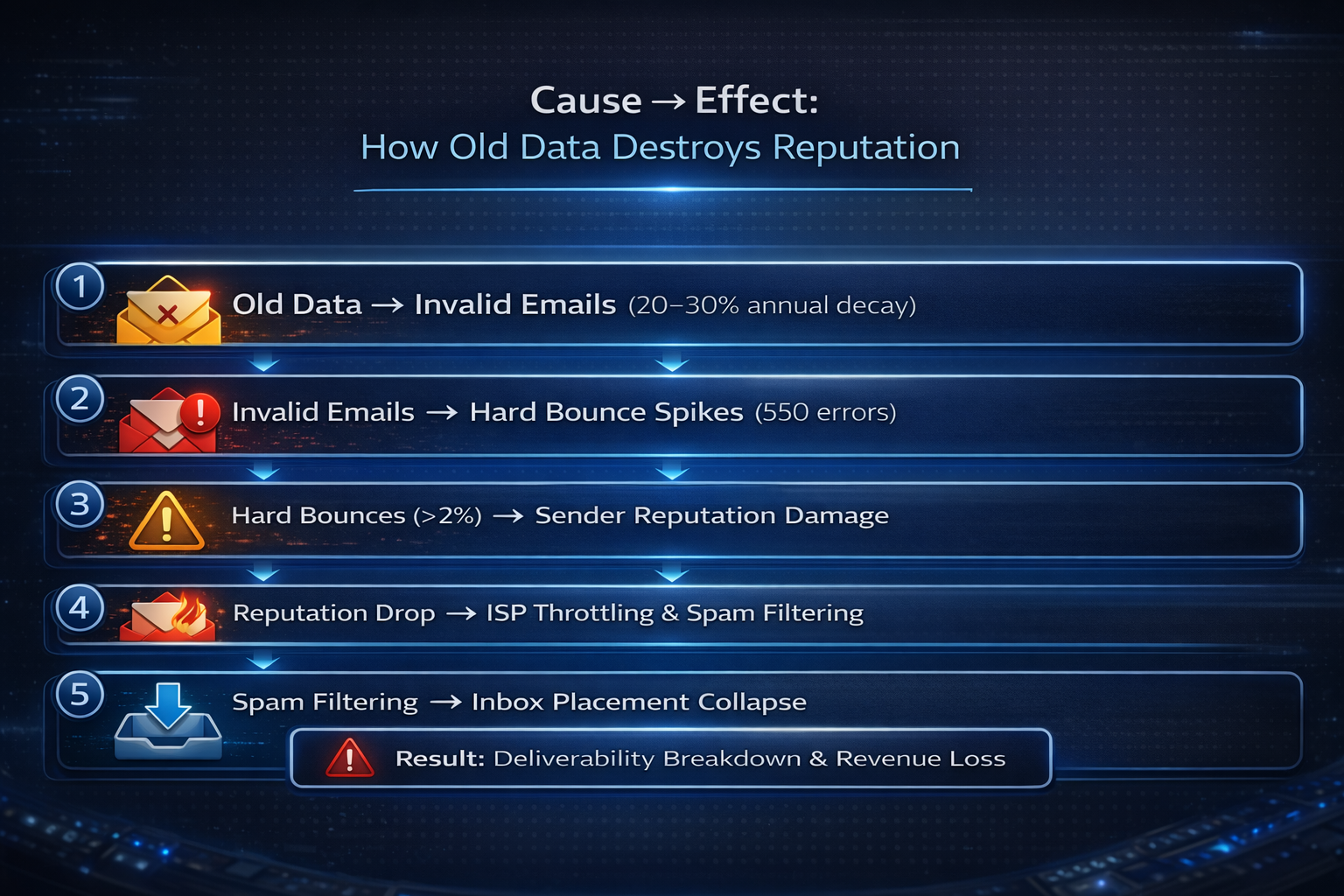
To understand why email list hygiene is critical in 2026, we must examine the linear progression of a deliverability collapse. In 2026, ISPs use telemetry to track how "fresh" a sender’s data is. When you ignore hygiene, you trigger a predictable chain reaction:
1. Old Data → Invalid Emails
The professional landscape in 2026 is more fluid than ever. People change jobs, companies consolidate, and free webmail accounts are abandoned in favor of secure, encrypted alternatives. Statistics show an average annual list decay rate of 20–30%. If your list hasn't been scrubbed in 12 months, nearly a third of your database is a technical liability.
2. Invalid Emails → Hard Bounce Spikes
Sending to these addresses results in immediate "550 - User Unknown" errors. In 2026, SMTP logs will be monitored in real-time by ISP neural networks. A sudden surge in 550 errors is interpreted as a "directory harvest attack" or the use of an outdated, non-permission-based list.
3. Hard Bounces → Sender Reputation Damage
ISPs in 2026 view a hard bounce rate exceeding 2% as a sign of poor collection practices. This damage isn't just local to one campaign; it attaches to your sending domain (DKIM) and your IP address. Once your reputation is tarnished, you lose the "benefit of the doubt" for future sends.
4. Reputation Damage → Throttling & Filtering
Once your reputation dips below a certain threshold in 2026, ISPs begin "throttling." They will only accept 50–100 emails per hour from your domain, regardless of your list size. Simultaneously, your mail is diverted to the junk folder to protect their users from perceived low-quality content.
5. Spam Filtering → Total Inbox Placement Decline
The ultimate effect in 2026 is the loss of your primary marketing channel. Your legitimate, high-value subscribers stop seeing your emails because your domain is now "guilty by association" with your own stale data. Recovering from a total inbox placement decline in 2026 can take 6–12 months of reputation rehabilitation.
The Silent Killer: Recycled Spam Traps
When you fail to remove inactive subscribers, you are inviting the most dangerous threat to your domain: the recycled spam trap.
Unlike "pristine" traps (emails created solely to catch scrapers), recycled traps are real email addresses that were once valid but have been abandoned. After a period of inactivity (usually 180 days in the 2026 standard), the ISP takes over the address and turns it into a trap.
If you send to these addresses, the ISP knows you are not practicing proper email list hygiene. You are sending to an address that hasn't opted-in for years. In 2026, hitting a single recycled spam trap can drop your "Sender Score" significantly, a deficit that takes months of perfect sending behavior to repair. For cold email agencieshitting a trap on a client’s domain can result in immediate contract termination and legal liability.
Industry-Specific Impact: The Cost of Negligence in 2026
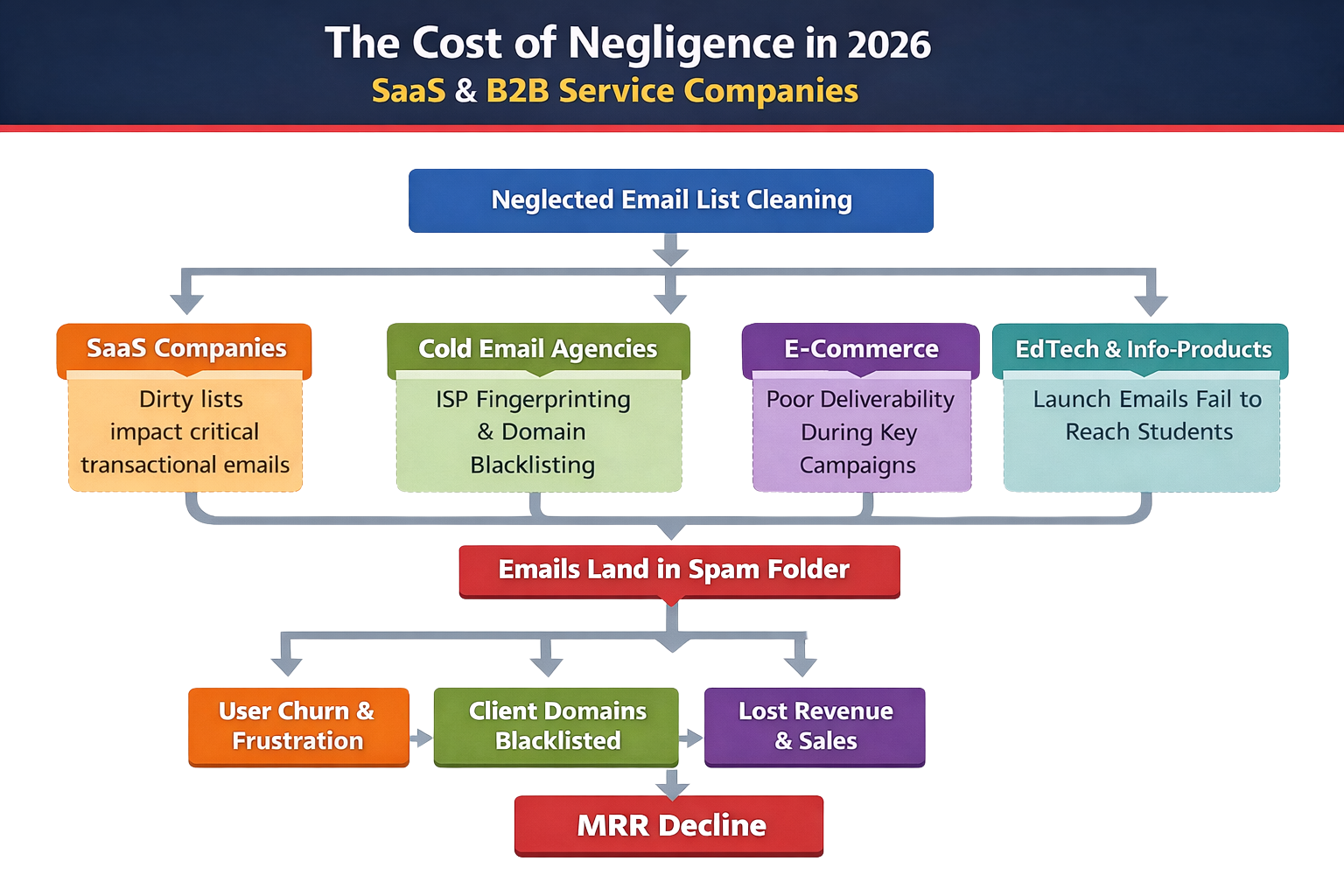
SaaS & B2B Service Companies
In the 2026 SaaS world, transactional and marketing emails often share a parent domain. If your marketing team sends a re-engagement campaign to a 2-year-old list without cleaning it, the resulting reputation hit can cause your critical password reset and onboarding emails to land in spam. This directly impacts churn, user experience, and ultimately, MRR.
Cold Email Agencies
For cold email agencies managing dozens of client domains in 2026, the risk is compounded. Using unverified old data across multiple domains can lead to "fingerprinting," where the ISP identifies the sending pattern and blacklists the entire agency infrastructure. You must treat list cleaning as a preventive control rather than a reactive one.
E-commerce
With the rise of "Privacy-Preserving Mail" features in 2026, open rates are less reliable. E-commerce brands that rely on massive lists for holiday sales often "wake up" dormant segments. Without list cleaning tips and tools, they risk having their most profitable campaigns of the year blocked by Gmail and Outlook.
EdTech & Info-Products
These verticals in 2026 often rely on massive historical databases. However, student and professional emails in EdTech have a higher-than-average decay rate as users move between institutions. Without a strict email verification checklistThese businesses often see their product launch emails fail to reach the inbox exactly when they need the revenue most.
List Cleaning as Domain Protection Infrastructure
Top-tier marketing automation managers in 2026 no longer view list cleaning as a cleanup task to be done before a holiday sale. Instead, it is positioned as infrastructure protection.
1. Preventive vs. Reactive Control
Reactive cleaning happens after you see a 10% bounce rate. By then, the damage is done. Preventive cleaning in 2026 involves automated verification at the point of entry and scheduled scrubbing of any segment that hasn't been mailed in 30 days.
2. Safeguarding Your Warm Status
Domain warming is a delicate process. If you have spent 4 weeks warming a new domain in 2026, sending to an old, uncleaned list in week 5 will reset your progress to zero. Improve inbox placement by ensuring every cold contact added to a sequence has been validated within the last 24 hours.
3. The Economics of Quality over Quantity
In 2026, the cost of an email send is no longer just the ESP fee; it's the "reputation tax." Mailing 10,000 clean leads is more profitable than mailing 50,000 unverified ones, as the latter carries a high probability of causing a 30% drop in overall reach for your best customers.
The Email Verification Checklist
To reduce email bounce rate and prevent email blacklisting, follow this technical checklist before hitting send on any legacy data.
Phase 1: Syntax and Physical Validation
- Remove Syntax Errors: Identify and purge emails with missing "@" symbols, trailing spaces, or invalid characters (e.g.,
name#company.com). - Eliminate Role-Based Addresses: Filter out
info@\,admin@\,support@\, andsales@\. In 2026, these often have multiple viewers and lead to higher complaint rates and lower engagement scores. - Identify Disposable Domains: Remove 10-minute mail addresses used by users to bypass gated content. These domains are frequently blacklisted by ISPs in 2026.
Phase 2: Domain and Server Verification
- MX Record Check: Confirm the recipient's domain actually has a mail server configured to receive mail. No MX record = immediate hard bounce in 2026.
- SMTP Handshake: Use a verification tool to ping the recipient's server to see if the mailbox exists without actually sending an email.
- Catch-all Detection: Flag "Accept-all" domains. These are risky for cold email agencies in 2026 because they cannot be verified with 100% certainty. Limit your volume to these addresses to under 5% of any given send.
Phase 3: Engagement and Safety Filtering
- Spam Trap Detection: Utilize a global database of known complainers and litigators to remove high-risk recipients who are likely to report you.
- 90-Day Engagement Scrub: Segment out any user who has not interacted with your brand in the last quarter of 2026. Move these to a re-verification bucket.
- Final Hygiene Pass: Run your list through a third-party hygiene service to detect toxic but technically valid emails, such as bot-generated addresses that are prevalent in 2026.
How to Re-Introduce Cleaned Data Without Triggering Filters
Once you have followed the list cleaning tips above, you cannot simply blast the entire list. Even clean old lists can be volatile because the recipients may no longer remember your brand, leading to a spike in spam complaints in 2026.
1.The Slow Drip Method: Mix your cleaned old data with your fresh high-engagement data. A ratio of 10% old to 90% fresh prevents the sudden shift in engagement signals that alerts ISP filters in 2026.
2.The Permission Reminder: In the header of your first email to an old list in 2026, include a brief note:"You are receiving this because you subscribed to [Brand] in the past. If your interests have changed, please unsubscribe here."
3.The Unsubscribe-First Strategy: For very old lists in 2026, consider a plain-text email asking them to confirm they still want to hear from you. Those who don't click are removed. This sacrifices volume for absolute reputation safety.
4.Monitor Telemetry in Real-Time: During the first 48 hours of sending to an old list in 2026, watch your "Time to Open" and "Bounce Type" logs. If you see "421" or "451" deferral codes, stop sending immediately; the ISP is questioning your data quality.
The Reputation Tax: Why Data Integrity is Your Only Real Asset
In 2026, a smaller, clean list is exponentially more valuable than a massive, dirty one. The cost of storing 100,000 inactive leads is negligible, but the cost of mailing them is the potential death of your domain reputation.
For marketing automation managersThe goal is delivery, not distribution. Distribution is just sending. Delivery is reaching the inbox. You cannot achieve the latter in 2026 without a ruthless commitment to hygiene.
If you are a cold email agency For a growth marketer, your domain is your most valuable asset. Treat it as such. Clean old email lists before sending in 2026 to ensure that when you have a message that truly matters, the gates to the inbox are actually open. The send button is a privilege—earn it by ensuring your data is as professional as your message.
Why 2026 Requires a Shift in Mentality
In the past, marketers could "get away" with a 5% bounce rate or a slightly messy list. Those days ended with the 2026 updates to major provider algorithms. Today, the ISP serves the recipient, not the sender. If you provide a poor experience by hitting an old, unmonitored mailbox, the ISP will prioritize the safety of their network over your marketing goals.
To improve inbox placement, you must think like a deliverability engineer. Every address on your list is a potential point of failure. By rigorously applying an email verification checklist and committing to email list hygiene, you differentiate your brand from the millions of low-quality senders currently being filtered out by the 2026 AI models.
Prevent email blacklisting by making list hygiene a weekly operational standard. In 2026, the winners are those who respect the inbox and protect their infrastructure with obsessive data care.
Here is a powerful, conversion-focused CTA to conclude your blog post:
Don’t Gamble with Your Domain Reputation in 2026
In the modern email ecosystem, you are only as good as your last send. One stale list, one recycled spam trap, or a single spike in hard bounces can undo years of domain warming and authority building. In 2026, "hope" is not a deliverability strategy—data integrity is.
Is your database a marketing asset or a technical liability?
Stop guessing and start validating. Use our best list List Cleaning Suite to scrub your legacy data, identify high-risk "zombie" accounts, and ensure your messages land in the inbox, not the junk folder.