Why Email Validation Is Important: 6 Reasons Every Sender Needs a Clean List
Every email you send to a dead, mistyped, or fake address costs you budget, sender reputation, and a chance to reach a real customer.
Email validation (also called email verification or list cleaning) checks whether an address is real and able to receive mail before you send, without sending an actual message. Done regularly, it ensures your campaigns reach people who can open them, which is where better open rates, more clicks, and higher conversions come from. Here is why it matters and what a good verification tool should check.
What Is Email Validation?
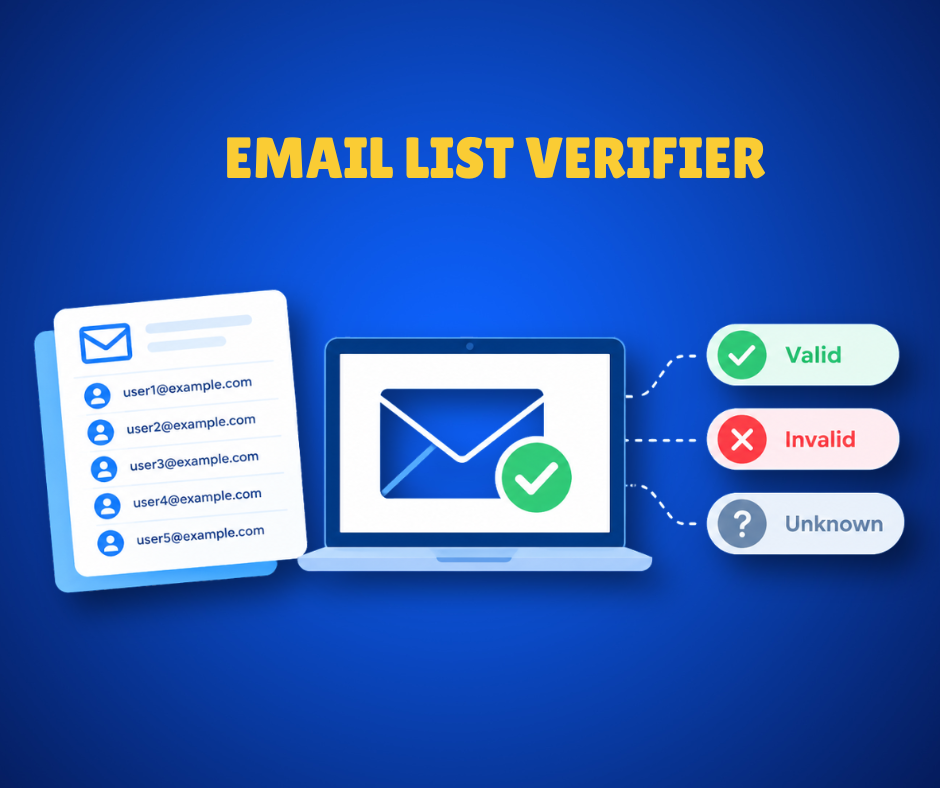
Email validation tests each address on your list to confirm that it is correctly formatted, belongs to a working domain, and points to a mailbox that exists. A good email list verifier sorts every contact into clear categories: deliverable, undeliverable, catch-all, and unknown.
For a sense of scale, here is a sample analysis of roughly 106,000 contacts:
| Status | Share of List |
|---|---|
| Deliverable | ~83% |
| Catch-all | ~8% |
| Undeliverable | ~6% |
| Unknown | ~3% |
That ~6% undeliverable slice is exactly what would have hard-bounced and damaged the sender's reputation.
1. Improve Email Deliverability
What's happening: Deliverability is the percentage of your emails that land in recipients' inboxes. Invalid, inactive, or mistyped addresses cause hard bounces, and mailbox providers read a high bounce rate as a sign of careless sending.
Why validation helps: Regular email list validation removes those addresses before you send. This protects your sender reputation and keeps future campaigns out of the spam folder.
2. Boost Engagement Rates
What's happening: A verified list is a relevant list. When every address is real and active, your open, click-through, and conversion rates reflect genuine interest instead of being dragged down by dead contacts.
Why it matters: Better engagement also sends positive signals to inbox providers, which helps future emails get placed well and strengthens your relationship with your audience.
3. Reduce Spam Complaints and Avoid Blacklists
What's happening: Old, abandoned addresses can become recycled spam traps, which blocklist operators use to catch senders with poor list hygiene. Hitting even a few can get your domain or IP blacklisted.
How validation reduces the risk:
- Flags spam traps and honeypots before you mail them
- Removes disposable and throwaway addresses
- Cuts the bounces that trigger provider penalties
4. Get More Value from Your Marketing Budget
What's happening: Email campaigns take real time and money, and many platforms charge by list size or send volume. Every invalid address is paid-for sending that can never produce a return.
Why validation helps: Cleaning your list first means your spend goes to real recipients, and it costs far less than repairing a damaged sender reputation. Look for a provider whose credits don't expire. Bouncify keeps purchased credits in your account until you use them, with plans starting at $12 for 3,000 credits.
5. Stay Compliant with Data Regulations
What's happening: Regulations such as GDPR, CCPA, and CAN-SPAM expect businesses to handle contact data responsibly, and accurate, current records are part of good data hygiene. Regularly removing outdated or invalid addresses supports that effort.
What to check in a provider:
- Encryption in transit and at rest
- No storage of message content
- Automatic deletion of uploaded lists after a set period
Bouncify states that it is GDPR and CCPA compliant, uses TLS and AES-256 encryption, and purges uploaded lists after 30 days. Validation supports compliance but does not replace consent, unsubscribe handling, or legal advice.
6. Enable Smarter Segmentation and Targeting
What's happening: Segmentation only works when the underlying data is accurate. With verified contacts you can:
- Separate safe-to-send contacts from risky ones such as catch-all addresses
- Identify role-based addresses (like info@ or support@) that behave differently from personal inboxes
- Build segments on reliable engagement data so your metrics mean something
The result: More relevant content for each audience group and stronger overall campaign performance.
What Should a Modern Email Validator Check?
Not all verification is equal. A thorough service runs several layers of checks. Bouncify's engine evaluates every contact across nine stages:
| # | Check | What It Does |
|---|---|---|
| 1 | Syntax and typo detection | Confirms RFC-compliant formatting; catches typos and illegal characters |
| 2 | DNS and MX validation | Verifies the domain exists and has working mail servers |
| 3 | SMTP handshake | Confirms the mailbox exists without sending a message |
| 4 | Anti-greylisting | Retries temporarily deferred servers so fewer addresses stay "unknown" |
| 5 | Spam trap and honeypot removal | Flags traps used by major blocklists |
| 6 | Disposable email filtering | Screens 3,500+ throwaway domains |
| 7 | Catch-all resolution | Detects accept-all domains and scores deliverability confidence |
| 8 | Automated deduplication | Clears duplicate contacts so you don't waste credits |
| 9 | Free list quality analysis | Previews list health before you spend credits |
Why anti-greylisting matters: Some servers temporarily reject first-time connections. Basic tools label these "unknown." A smarter engine waits and retries, which Bouncify says resolves up to 20% of deferred addresses into usable leads.
Why catch-all handling matters: Catch-all servers accept mail for any address, real or not, so you can't be certain a specific mailbox exists. A good verifier flags them separately so you can set your own risk level.
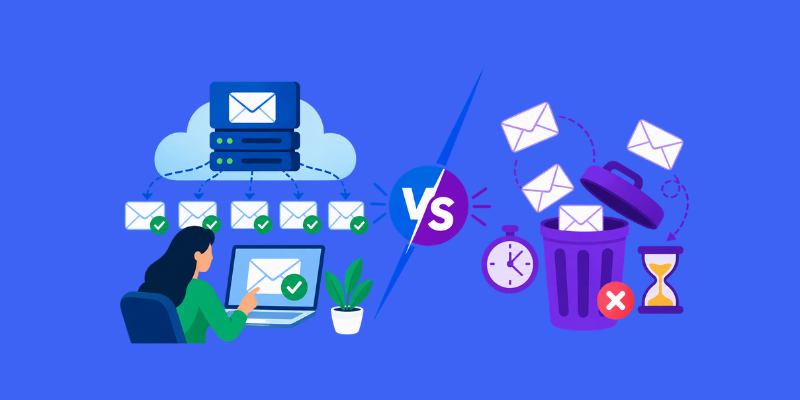
Real-Time vs. Bulk Validation
Use both, because they solve different problems.
Bulk list cleaning means uploading a CSV or syncing from your CRM to scrub an existing database. See bulk email verification.
Real-time API validation checks addresses at the point of capture (sign-up, checkout, lead forms) so bad data never enters your system. Bouncify's email verification API advertises average response times under 100 ms.
Blocking a fake address at the form is cheaper than cleaning it up later.
How to Clean Your Email List in 3 Steps
- Upload your list. Drop in a CSV, paste contacts, or import from tools like HubSpot, Mailchimp, or Google Sheets.
- Run verification. The engine performs the checks above on every contact.
- Download the safe contacts. Export your deliverable leads and handle risky ones (catch-all, unknown) according to your risk tolerance.
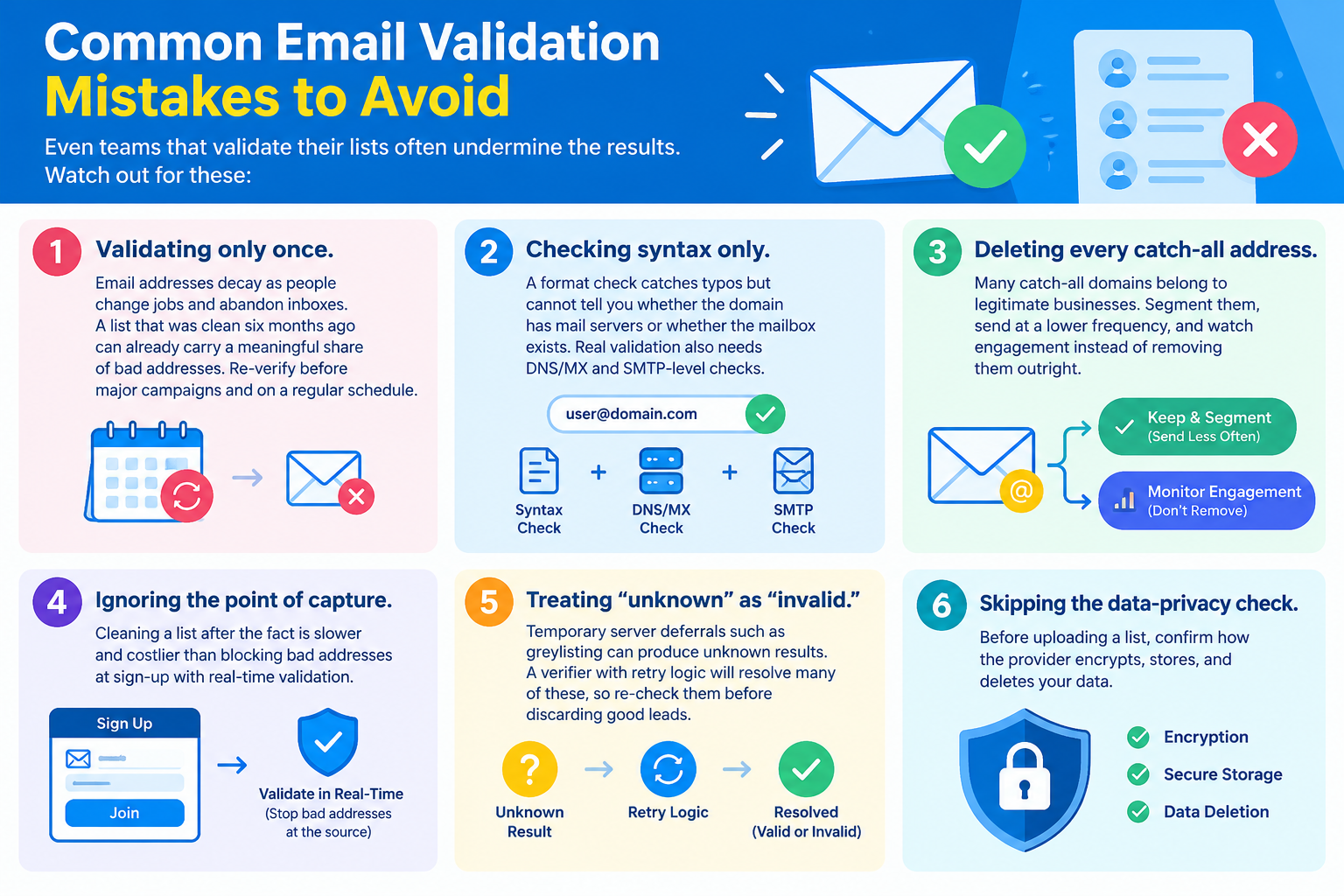
Common Email Validation Mistakes to Avoid
Even teams that validate their lists often undermine the results. Watch out for these:
Validating only once. Email addresses decay as people change jobs and abandon inboxes. A list that was clean six months ago can already carry a meaningful share of bad addresses. Re-verify before major campaigns and on a regular schedule.
Checking syntax only. A format check catches typos but cannot tell you whether the domain has mail servers or whether the mailbox exists. Real validation also needs DNS/MX and SMTP-level checks.
Deleting every catch-all address. Many catch-all domains belong to legitimate businesses. Segment them, send at a lower frequency, and watch engagement instead of removing them outright.
Ignoring the point of capture. Cleaning a list after the fact is slower and costlier than blocking bad addresses at sign-up with real-time validation.
Treating "unknown" as "invalid." Temporary server deferrals such as greylisting can produce unknown results. A verifier with retry logic will resolve many of these, so re-check them before discarding good leads.
Skipping the data-privacy check. Before uploading a list, confirm how the provider encrypts, stores, and deletes your data.
Wondering How Clean Your List Really Is?
Before you hit send on your next campaign, run your list through Bouncify. New accounts get 100 free credits with no credit card needed, and credits never expire. Bouncify flags invalid, disposable, and catch-all addresses separately, giving you a clearer picture of which contacts to keep, which need a closer look, and which to remove.
Ready to see how your list breaks down? Verify your email list today and get a clear, categorized view of every address.
Conclusion
Email validation is one of the cheapest, highest-impact steps in email marketing. It improves deliverability, lifts engagement, lowers spam and blacklist risk, saves budget, supports compliance, and makes segmentation more reliable. If you rely on email to reach customers, make verification a routine part of your process rather than a one-time fix, because clean data helps every campaign you send afterward.