Bouncify Speeds Up Catch-All Email Verification With Faster, More Accurate Results
- Bouncify can now resolve many catch-all email addresses during standard verification, with no extra steps needed.
- You get clearer results sooner and no longer have to wait on slower follow-up checks for many of these addresses.
- The update covers many catch-all addresses on Microsoft 365, Google Workspace, and other major business email providers.
Catch-all addresses used to mean a pause in your workflow. With Bouncify's latest update, many of them are now classified right away, and you still see which domains are set up as catch-all.
Few things in email verification cause more headaches than catch-all domains.
If you've ever cleaned a list and found a big chunk of it marked "catch-all" or "accept-all," you know the feeling. These domains accept mail for any address, real or not, so it's hard to tell which contacts are actually safe to send to.
Until now, getting a clearer answer on many of these addresses meant extra processing, which could slow down your campaign launch. Today, we're changing that.
What is catch-all email verification?
Catch-all email verification is the process of checking addresses on domains that are set up to accept messages for any recipient, whether or not a real mailbox exists behind it.
For example, a company might configure its domain so that all of these are accepted:
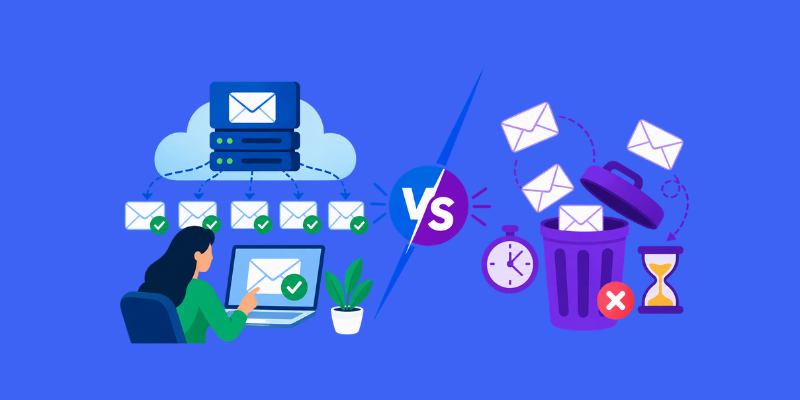
Because the server says "yes" to everything, standard checks can't easily confirm whether a specific inbox is real. That's why most verification tools simply label these addresses as catch-all and leave you to guess.
Bouncify now resolves many catch-all emails in standard verification
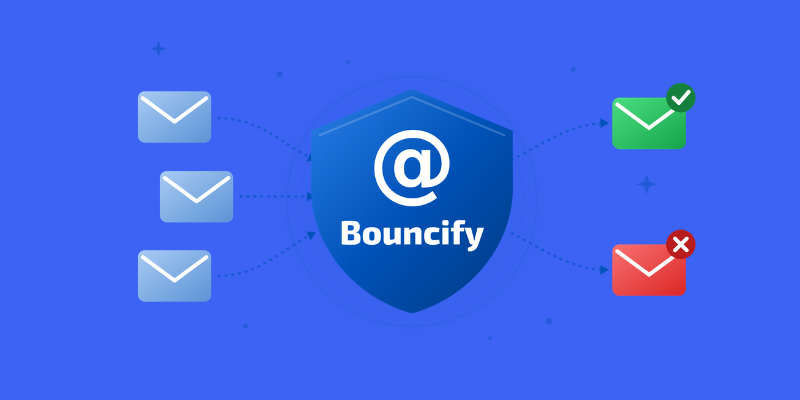
With this update, Bouncify can determine whether many catch-all addresses are deliverable or undeliverable as part of the regular verification run. Instead of handing you a long list of unresolved catch-all results, we now sort many of them into clear outcomes automatically.
This means you can move from "uploaded" to "ready to send" faster, without waiting on extra verification steps.
The improvement applies to many catch-all addresses hosted on Microsoft 365, Google Workspace, and major secure email gateways (SEGs).
You still see catch-all domain insights
Whenever a tool gets better at resolving catch-all addresses, there's a fair question: will I lose sight of which domains are catch-all?
No. Even when Bouncify marks an address as deliverable or undeliverable, we still flag whether its domain is configured as catch-all.
| Email address | Verification result | Catch-all domain |
|---|---|---|
| alex@company.com | Deliverable | Yes |
| alex.test@company.com | Undeliverable | Yes |
That gives you two useful signals:
- Whether the individual address looks valid
- Whether the domain accepts mail for everything
Together, they help you judge list quality with more confidence.
What this means for your email lists
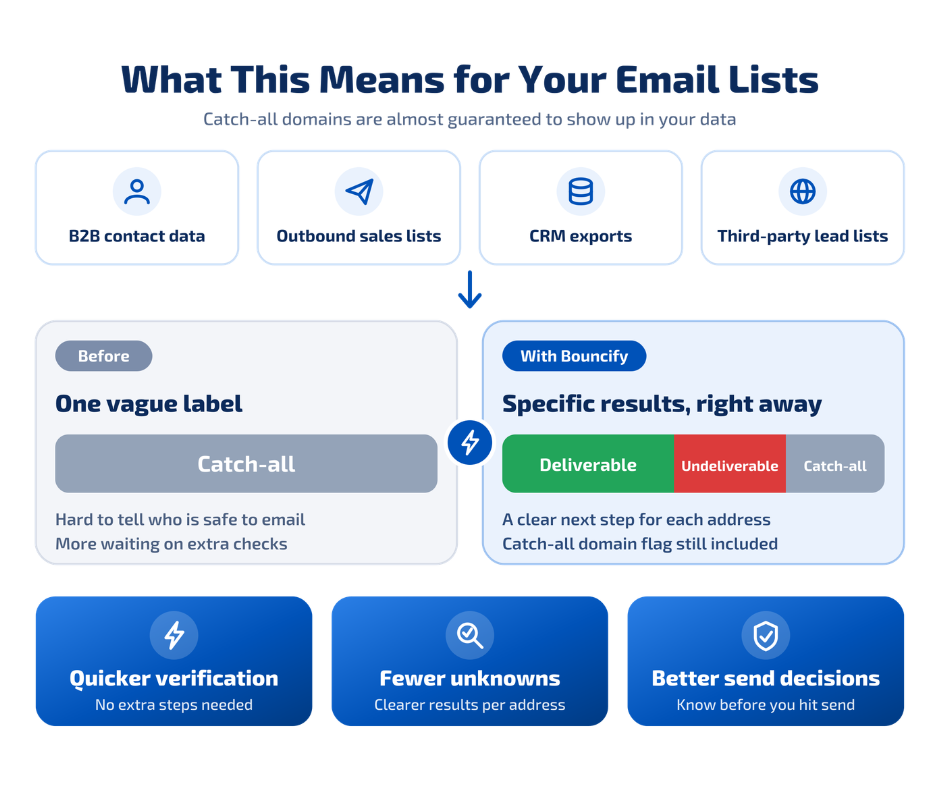
If you work with B2B contact data, outbound sales lists, CRM exports, or lead lists from third-party sources, catch-all domains are almost guaranteed to show up.
This update cuts down the guesswork. Rather than seeing a large share of your list sitting under a single vague label, you get more specific results right away. That means a quicker verification process, fewer unknowns, and better decisions before you hit send.
A faster path to a cleaner list
The purpose of email verification is simple: protect your sender reputation and help your messages reach real people. By resolving many catch-all addresses up front, Bouncify gives you answers sooner while keeping the domain-level insight you rely on.
The change is especially useful if your contacts are mostly business emails on Microsoft 365, Google Workspace, or other major platforms.
If catch-all results have been slowing down your list cleaning, this update should help you move faster and send with more confidence.