How to Simplify Email Marketing Without Hurting Deliverability
To simplify email marketing without sacrificing performance, high-volume senders must shift from reactive troubleshooting to proactive infrastructure.
True simplification isn’t about removing essential safeguards—it’s about automating them. By making email list hygiene and continuous email verification foundational parts of your workflow, you eliminate the technical debt caused by hard bounces, spam traps, and reputation decay.
This approach allows marketing teams to focus on strategy and scaling while ensuring their sender reputation remains intact and their inbox placement stays consistent.
In the pursuit of operational efficiency, many high-volume senders fall into the "efficiency trap."
To save time, marketing teams often streamline their workflows by removing what they perceive as "extra steps"—manual list audits, complex segmentation, or rigorous data cleaning.
However, in the ecosystem of modern ISP (Internet Service Provider) filtering, what looks like simplification can quickly manifest as a deliverability crisis. When you remove the safeguards that manage data quality, your sender reputation pays the price.
The challenge is not just doing less; it’s about doing the right things automatically so you can focus on strategy without ending up in the spam folder. This guide explores how to simplify your email operations while strengthening your foundational deliverability.
The Efficiency Trap: Why "Simple" Often Leads to Spam
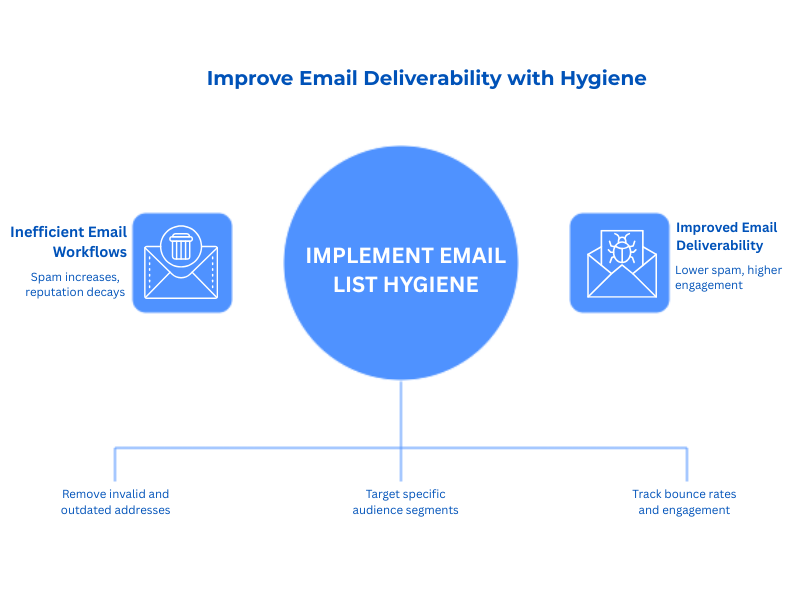
When marketers simplify their workflows by ignoring email list hygiene, they inadvertently increase the "noise" sent to ISPs like Gmail and Microsoft 365. These providers use sophisticated machine learning models to evaluate your sender reputation based on the quality of your traffic.
If you simplify your process by sending to your entire database without verification, you face three immediate technical risks:
- Reputation Decay: As your hard bounce rate climbs above 2%, ISPs begin to view your mail stream as unsolicited or poorly managed.
- Spam Trap Hits: Legacy email lists often contain "recycled" addresses—old accounts turned into traps by ISPs to identify senders with poor data practices.
- Engagement Weighting: Simplifying by removing segmentation often leads to lower open rates. Lower engagement signals to ISPs that your content isn't wanted, leading to aggressive inbox placement issues.
1. Shift from Manual Audits to Automated Hygiene
The most effective way to simplify without risk is to move from reactive cleaning to proactive email verification.
Instead of waiting for a deliverability crisis to audit your list, integrate verification into your core workflow. By validating addresses at the point of entry or immediately before a major campaign, you eliminate the need for manual troubleshooting later.
Why Data Quality is Non-Negotiable
Email data decays at an average rate of 2% per month. People change jobs, delete accounts, and abandon old handles. If you haven't mailed a segment in 90 days, that list is technically "stale." Sending it without a hygiene check is one of the fastest ways to trigger throttling or a temporary IP block.
2. Decoupling IP and Domain Reputation
To simplify your infrastructure, you must understand the two pillars of reputation:
- IP Reputation: Tied to the physical server sending the mail. This is critical for high-volume senders who need to maintain consistent "warm" traffic.
- Domain Reputation: This follows your brand regardless of which ESP (Email Service Provider) you use. It is heavily influenced by how users interact with your specific "From" address.
Simplification should never involve swapping domains or IPs to "outrun" bad stats. Instead, protect your domain reputation by ensuring every address on your list has been verified as "deliverable." This creates a clean baseline that allows ISP filters to focus on your content rather than your data quality.
✅ Verify Your Email List with Bouncify
3. Standardize Your Authentication Stack
One area where you should never "simplify" by cutting corners is authentication. To the contrary, simplifying your technical overhead means getting your SPF, DKIM, and DMARC records right once so you don't have to touch them again.
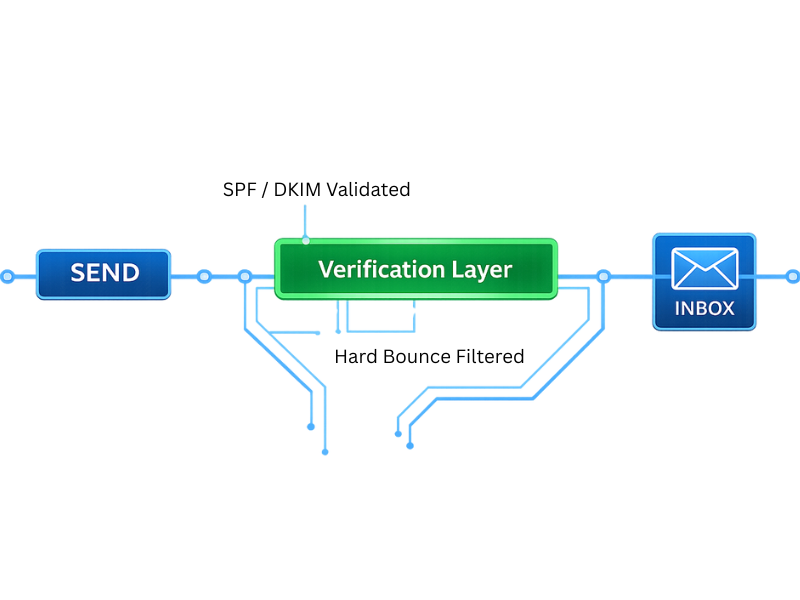
Proper authentication serves as a digital passport. It tells the receiving server that you are exactly who you say you are. Without it, even the cleanest list will struggle with email deliverability.
- SPF (Sender Policy Framework): Lists the IPs authorized to send on your behalf.
- DKIM (DomainKeys Identified Mail): Add a cryptographic signature to your emails.
- DMARC (Domain-based Message Authentication, Reporting, and Conformance): Provides instructions to the ISP on what to do if the first two fail.
4. Pruning Legacy Email Lists
A common mistake in high-volume sending is the "fear of letting go." Marketers keep legacy email lists because they represent potential revenue. However, from a deliverability engineering perspective, these are liabilities.
Simplifying your list management means implementing an automated sunset policy:
- Identify: Flag users who haven't opened an email in 6–12 months.
- Verify: Run these users through an email verification tool to see if the accounts are still active.
- Re-engage or Remove: Attempt one re-engagement campaign. If they don't respond, remove them.
This keeps your "active" list lean and your engagement metrics high, which are primary signals for healthy inbox placement.
5. Cause and Effect: The Deliverability Chain
To maintain control while simplifying, you must monitor the relationship between your actions and ISP responses:
| Action (The Simplification) | The Risk | The Safeguard |
|---|---|---|
| Sending to old, unmailed lists | High hard bounce rate | Bulk email list hygiene check before send |
| Increasing volume rapidly | Throttling and blocks | Gradual volume ramping (Warm-up) |
| Using "Catch-all" addresses | Increased spam complaints | Removing high-risk/invalid addresses |
| Skipping segmentation | Low engagement / Junk folder | Verifying intent and address validity |
The Role of Verification as Infrastructure
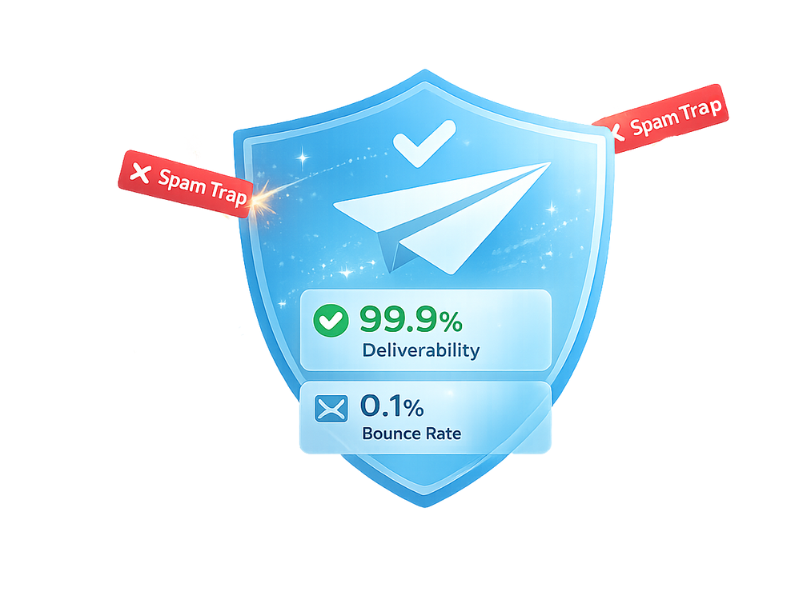
Think of email verification not as an extra task, but as a filter in a water system. You can simplify the plumbing all you want, but if the water is contaminated, the system fails.
By utilizing verification as a preventive control, you allow your marketing team to:
- Reduce the time spent analyzing bounce logs.
- Avoid the "reputation recovery" cycles that take months to fix.
- Ensure that budget is only spent on reaching real humans.
Action Checklist: Simplification with Integrity
To simplify your workflow while protecting your sender reputation, follow this operational framework:
- Audit Your Entry Points: Ensure your sign-up forms use double opt-in or real-time verification to keep bots and typos out of your database.
- Automate List Cleaning: Schedule a monthly hygiene check for your primary segments to catch account churn before it impacts your bounce metrics.
- Monitor Postmaster Tools: Use tools like Google Postmaster to track your domain reputation and spam complaint rates.
- Validate Before Big Sends: If you are launching a product or a holiday campaign to a wider audience, verify that segment 24 hours before hitting "send."
- Focus on Engagement: Send fewer, better emails. High engagement is the ultimate "cheat code" for deliverability.
Conclusion: Clean Data Enables Scalability
Simplifying email marketing is a noble goal, but it cannot come at the expense of your technical foundation. True simplification is achieved through automation and prevention, not by ignoring the health of your list.
When you prioritize email list hygiene, you remove the volatility from your deliverability. You gain the confidence to scale your volume, knowing that your sender reputation is protected by a layer of verified, high-quality data.
**Next Steps for Long-Term Health:**
- Review your current bounce rates. Anything over 1% warrants a list audit.
- Check your DMARC compliance to ensure your domain is secure.
- Implement a routine verification process to keep your data "inbox-ready."
Ready to clean your list? Start with free email verification